
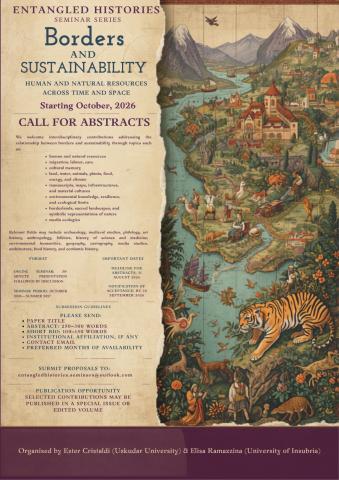
Call for Papers Entangled Histories Seminar Series 2026–2027 Theme: Borders and Sustainability: Human and Natural Resources across Time and Space
Following the success of the previous edition, the Entangled Histories Seminar Series invites abstracts for its 2026–2027 cycle.
This entire seminar series will be held fully online and will offer a publication opportunity with a leading global academic publisher for a selection of the most significant contributions.
We warmly welcome contributions from Labour History, Social and Economic History, Political Economy, Historical Sociology, Gender Studies, Oral History, and Industrial Archaeology, adopting an interdisciplinary, diachronic perspective that spans a wide chronological trajectory from prehistory and antiquity, through the medieval and early modern eras, up to the modern and contemporary periods. In alignment with H-Labor’s mission to foster international discussion on the history of workers, this series encourages proposals that investigate how working-class populations, guilds, trade unions, and migratory labourers negotiated, represented, and sustained their livelihoods in relation to ecological limits, resource allocation, and the shifting dynamics of territorial, institutional, and socioeconomic boundaries (borders).
Sustaining Labour: Boundaries, Working Lives, and Resource Extraction in History
This edition explores sustainability not as a modern corporate framework, but as a critical historical issue centred on the long-term reproduction, survival, and resistance of human labour in the face of environmental limits and border enforcements. The series investigates these dynamics across several interconnected dimensions:
- Socio-Institutional Sustainability, Labour Scarcity, and Vulnerable Populations: The history of how communities managed the social and material sustainability of working populations (including rural labourers, early industrial workers, and particularly vulnerable groups such as children, women, and the elderly) during periods of economic transition, environmental crises, or plagues; the history of occupational health, foodways, and institutional welfare.
- Geopolitical Borders, Labour Mobility, and Migratory Frontiers: The impact of territorial boundaries, customs lines, and administrative partitions (with a particular interest in shifts before and after 1725) on the movement of workers; the history of seasonal migration, cross-border agricultural labour, maritime crews, and how physical borders conditioned access to employment and material resources.
- Traditional Ecological Knowledge (TEK), Resource Commons, and Agrarian Labour: The historical analysis of the work involved in land, water, and forest management; how the generational knowledge of rural workers, miners, woodcutters, and smallholders regulated common-pool resources (the commons); the historical clashes between community-based sustainable work practices and the imposition of capitalistic borders or enclosures.
- Ecological Sustainability, Material Reuse, and the Work of Recycling: The environmental history of dangerous or intensive resource extraction (mining philosophies, logging, quarrying) and the physical toll on labourers; the material culture and social history of recycling, junk-picking, and the structural reuse of waste or industrial infrastructures by working-class communities.
- Textual Sustainability, Corporative Philology, and the Rewriting of Guild Regulations: The textual transmission, translation, and systematic reuse or adaptation of labour customary laws, merchant codes, guild statutes, and workshop regulations; how workers' rights and occupational parameters were written and rewritten across shifting linguistic, regional, and national frontiers.
- Global Elemental Theory, Humoral Ecology, and the Working Body: The history of ideas surrounding the working body's exposure to natural forces and environmental elements (earth, water, air, fire); how historical medical-dietetic systems or theories of bodily moisture/stamina were applied to maximise, regulate, or defend the health of manual labourers in toxic or demanding work environments.
- The Epistemological Status of Worker Folklore and Oral Histories: Methodological reflections on oral history, working-class memory, and local micro-histories; how regional working-class folklore, protest songs, vernacular weather adaptations, and trade myths served as alternative archives to document socio-environmental transformations and everyday resistance against border regimes.
- Symbolic, Visual, and Performing Arts of Labour Landscapes: Representations of work, physical effort, and socio-ecological boundaries in proletarian literature, early modern iconography, and company ledgers; the staging of labour conflicts or community thresholds in drama, and the modern media or cinematic representation (such as industrial films or social realism) of labour trauma and heritage.
At the heart of the series lies the concept of borders, understood as dynamic thresholds—whether geographic barriers, political lines, class divisions, or the conceptual boundaries separating free from unfree labor, text from body, and material resources from the human hands that extract them—that have historically mediated access to livelihoods, defined solidarity, and shaped the shared, entangled histories of global working societies.
Topics of Interest
We welcome contributions from a wide range of academic disciplines, including:
- Labour History and Social History: History of trade unions, working-class movements, guild structures, slavery and unfree labour, strikes, working-class gender history, and the international circulation of labour philosophies.
- Economic History and Political Economy: History of capitalism, trade networks, resource monopolies, agrarian regimes (such as sharecropping or tenant farming), and the macro-economic management of human and natural resources.
- Environmental History and Historical Ecology: The environmental footprint of mining, deforestation, and industrialisation; the history of hydraulic labour, environmental hazards, and occupational safety.
- Folklore, Oral History, and Anthropology: Collecting and analysing workers' oral testimonies, memory studies of deindustrialisation, vernacular industrial culture, and the ethnography of working-class borderlands.
- Prehistory and Antiquity: Early divisions of labour, ancient mining operations, public works construction, resource management prior to state consolidation, and the archaeology of early human landscape adaptation and tool/material reuse.
- Medieval and Pre-Modern Studies: Monastic labour systems, feudal obligations, urban crafts, early maritime labour contracts, manuscript production as labour, and the material or textual reuse and rewriting of older regulatory traditions.
- Archaeology, Anthropology, and Material Culture: Industrial archaeology, field archaeology of worker settlements and housing, the material culture of borders, and the bioarchaeology of occupational stress, diet, and trauma.
- Art History, Architecture, and Heritage Studies: Iconography of labour, architectural history of factories, worker housing, and outposts, and the critical heritage preservation or exploitation of industrial and rural cultural landscapes.
- Media Studies, Cinema, and Theatre: The cinematic representation of working-class lives, strikes, and eco-trauma; the performance of labour and class thresholds in historical and contemporary drama; and the role of media in shaping collective historical memory.
Seminar Format & Schedule
- Format: Online seminar via Zoom (Approx. 30-minute presentation followed by discussion). Scheduling will take international time zones into account as much as possible.
- Schedule: October 2026 – Summer 2027.
Submission Guidelines & Selection Rules
Proposals must be submitted in English and include the following details:
- Title of the proposed paper.
- Abstract (250–300 words).
- Short biographical note (100–150 words).
- Institutional affiliation (if any) or independent scholar status.
- Contact email.
- Preferred months of availability (between October 2026 and Summer 2027).
⚠️ MANDATORY ABSTRACT CRITERIA: The abstract submitted MUST clearly explain how the proposed paper intends to address and integrate the central core topics of the series: Borders (confini) and Sustainability (sostenibilità) within your specific labor historical, geographic, or socio-economic framework. Proposals that fail to explicitly address this conceptual intersection will not be considered.
⚠️ CRITICAL SUBMISSION REQUIREMENT: All submission materials (title, abstract explaining the approach to borders and sustainability, bio, affiliation, and availability) MUST be compiled and submitted into a SINGLE file (either .doc, .docx, or .pdf). Multiple attachments will not be considered.
Please submit your single-file proposal to: entangledhistories.seminars [@] outlook.com
Important Dates
- Deadline for abstracts: 31 August 2026
- Notification of acceptance: By 30 September 2026
Publication Opportunity A selection of the most significant contributions will be published in a special issue or in a dedicated edited volume with a major, world-leading academic publisher.
Organised by:
- Dr Maria Pia Ester Cristaldi (Üsküdar University)
- Dr Elisa Ramazzina (University of Insubria)
Under the patronage of:
The Faculty of Communication and the Master’s Programme in Media and Cultural Studies at Üsküdar University.
